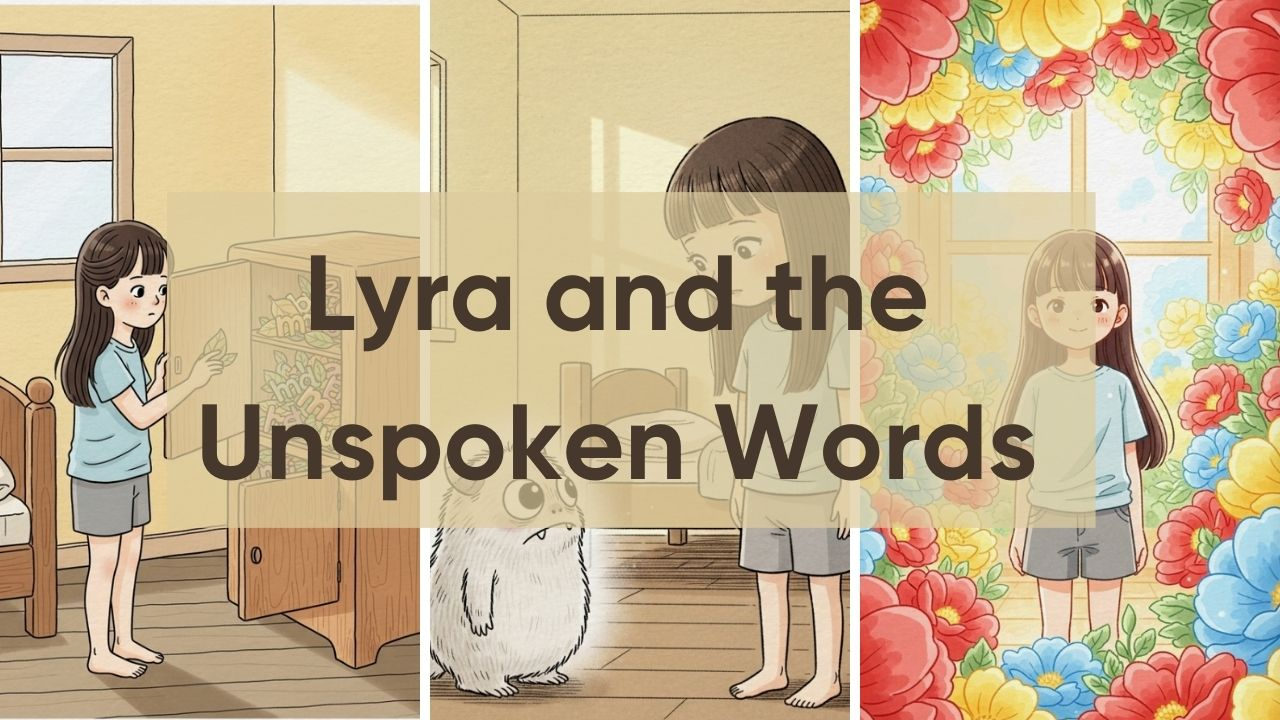
Hello everyone! Today, we’re going to learn some practical Japanese vocabulary and grammar through a heartwarming story, “Lyra and the Unspoken Words.” This story is not only touching but also full of expressions that can be used in daily life.
Let’s hear the story in Japanese, then English before jumping into the article. By reading the story, you will learn some useful phrases and idioms that you can you right away in life. Let’s get started.
1. Describing Locations and Existence: Story opening: 「静かな小さな町に、ライラという女の子が住んでいました。」(Shizuka na chiisana machi ni, Raira to iu onnanoko ga sunde imashita.) – “In a quiet small town, there lived a girl named Lyra.”
- 静かな (shizuka na): Adjective meaning “quiet.” Japanese adjectives are divided into “i-adjectives” and “na-adjectives.” 静か is a “na-adjective,” so “な” is added when modifying a noun.
- 小さな (chiisana): Adjective meaning “small.” It’s similar in meaning to 「小さい (chiisai)」, but 「小さな」 is more often used as an attributive adjective directly modifying a noun, carrying a literary nuance.
- ~に、~がいます/あります (~ni, ~ga imasu/arimasu): Indicates “there is/are something/someone in a certain place.” 「います (imasu)」 is used for people or animals, while 「あります (arimasu)」 is for inanimate objects. In the story, Lyra lived in the town, so 「住んでいました (sunde imashita)」 (was living) is used.
- ~という (~to iu): Indicates “named ~” or “called ~.” For example, 「ライラという女の子 (Raira to iu onnanoko)」 means “a girl named Lyra.”
2. Habits and Purpose of Actions: 「心に何かあっても口に出せないとき、彼女はその言葉をそっとこの戸棚に「しまう」のです。」(Kokoro ni nani ka atte mo kuchi ni dasenai toki, kanojo wa sono kotoba o sotto kono todana ni “shimau” no desu.) – “When she had something on her mind but couldn’t say it, she would quietly “put away” those words in this cupboard.”
- ~ても (~te mo): Means “even if/though ~.” For example, 「何かあっても (nani ka atte mo)」 means “even if there’s something.”
- 口に出せない (kuchi ni dasenai): Verb meaning “cannot say aloud.” Literally, “cannot put out of mouth.” This is the potential negative form of 「口に出す (kuchi ni dasu)」 (to say aloud).
- ~とき (~toki): Means “when ~.”
- そっと (sotto): Adverb meaning “quietly, gently.”
- しまう (shimau): Verb meaning “to put away, to store.” Here, it’s used metaphorically to mean “to hide away” words.
- ~のです (~no desu): An explanatory or emphatic sentence ending, making the statement more convincing or emphasizing a reason.
3. Changes and Continuations of State: 「日ごとに、戸棚の中の「言わない言葉」は増えていきました。」(Hi goto ni, todana no naka no “iwanai kotoba” wa fuete ikimashita.) – “Day by day, the “unspoken words” inside the cupboard increased.”
- 日ごとに (hi goto ni): Means “day by day, day after day.”
- 言わない (iwanai): Verb meaning “unspoken, not said.” It’s the negative form of 「言う (iu)」 (to say), directly modifying the noun 「言葉 (kotoba)」 (words).
- ~ていく (~te iku): Indicates “to continue doing” or “to gradually change.” Here, 「増えていく (fuete iku)」 means “to gradually increase.”
- 「戸棚はもう何も入らなくなりました。」(Todana wa mō nani mo hairanaku narimashita.) – “Eventually, the cupboard could no longer hold anything.”
- もう~ない (mō ~nai): Means “no longer ~.”
- ~なくなる (~naku naru): Means “to become unable to ~.” For example, 「入らなくなる (hairanaku naru)」 means “to become unable to be put in/hold.”
4. Expressing Emotions and Metaphors: 「それは大きな目と尖った歯を持っていて、少し怖く見えましたが、同時に少し途方に暮れているようでもありました。」(Sore wa ookina me to togatta ha o motte ite, sukoshi kowaku miemashita ga, dōji ni sukoshi tohou ni kurete iru yō demo arimashita.) – “It had big eyes and sharp teeth, looking a little scary, but at the same time, it also seemed a little bewildered.”
- 尖った (togatta): Adjective meaning “pointed, sharp.” It’s the past tense of the verb 「尖る (togaru)」 (to be pointed), used to modify a noun.
- ~ていて (~te ite): The continuative form of the verb 「~ている」, connecting two actions or states.
- 怖く見えましたが (kowaku miemashita ga): The adverbial form of the i-adjective 「怖い (kowai)」 (scary) is 「怖く」, combined with 「見える (mieru)」 (to look) it means “looked scary.” The following 「が」 indicates a contrast, “but.”
- 途方に暮れている (tohou ni kurete iru): An idiom meaning “to be at a loss, bewildered, helpless.”
- ~ようでした (~yō deshita): Indicates “it seemed like ~, it appeared that ~.”
5. Determination and Action: 「ライラは深呼吸をして、勇気を振り絞り、一番近くのモンスターに話しかけました。」(Raira wa shinkokyū o shite, yūki o furishibori, ichiban chikaku no monsutā ni hanashikakemashita.) – “Lyra took a deep breath, mustered her courage, and spoke to the nearest monster.”
- 深呼吸をする (shinkokyū o suru): An idiom meaning “to take a deep breath.”
- 勇気を振り絞る (yūki o furishiboru): An idiom meaning “to muster courage, to exert all one’s strength.”
- 話しかける (hanashikakeru): Verb meaning “to speak to, to address.”
6. Turning Point and Result: 「彼女が心からの真実を話すたびに、モンスターたちは小さくなり、その輝きは増していきました。」(Kanojo ga kokoro kara no shinjitsu o hanasu tabi ni, monsutā-tachi wa chiisaku nari, sono kagayaki wa mashite ikimashita.) – “Every time she spoke the truth from her heart, the monsters became smaller, and their glow increased.”
- 心からの (kokoro kara no): Adjective meaning “from the heart, sincere.”
- ~たびに (~tabi ni): Means “every time ~.”
- ~ていく (~te iku): Appears again, emphasizing “gradual change” or “continuous progression.”
We hope this article helps you better understand the story “Lyra and the Unspoken Words” and learn practical Japanese expressions from it!
*The story is created with the help of AI.